Overview
There are bowhead whales alive in the Arctic today that were already adults before the aeroplane was invented. Some may have been swimming when Moby-Dick was written. The bowhead is the longest-lived mammal known to science, with credible estimates placing the maximum lifespan beyond two hundred years — a scale of individual memory that no other warm-blooded animal on Earth approaches.
It is a creature of superlatives, but quietly so. It has the thickest blubber and the thickest skin of any whale, the longest baleen, the lowest core body temperature, and proportionally the largest head and mouth of any animal that has ever lived. It breaks through solid sea ice with its skull in order to breathe. And it sings — with a vocal range that researchers have compared to jazz improvisation, producing a repertoire so varied it stands almost alone among mammals.
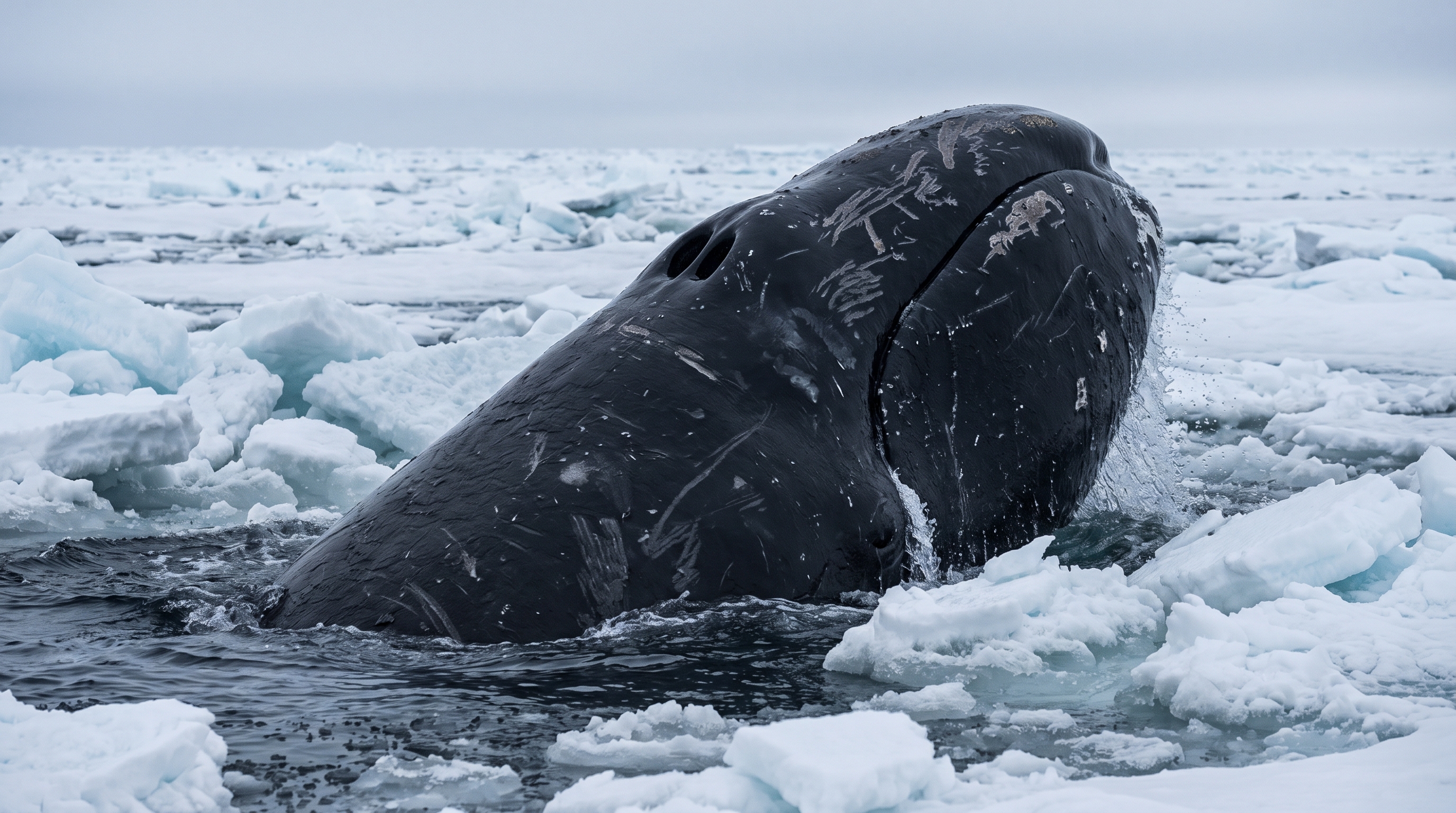
A bowhead whale surfacing through a lead in Arctic sea ice, its massive arched head breaking the surface among broken floes
Two Human Lifetimes
The Iñupiat of Alaska's North Slope, who have hunted the bowhead for over four thousand years, have long held that bowheads live two human lifetimes. For most of the twentieth century, Western science estimated the bowhead lifespan at sixty or seventy years, comparable to other large whales. The Indigenous knowledge was, as it turned out, considerably closer to the truth.
The correction came from the whales themselves. In the late twentieth and early twenty-first centuries, Iñupiat hunters recovered stone harpoon points and fragments of Victorian-era bomb lances from the bodies of whales taken in subsistence hunts. These were weapons that had gone out of manufacture in the 1880s and 1890s. The animals carrying them had survived the wound, healed around the metal, and gone on living for more than a century afterward.
The chemical clock
Physical evidence establishes a minimum. To estimate the maximum, researchers turned to the eye. The lens of a mammal's eye contains proteins laid down early in life that remain stable thereafter, slowly converting from one molecular form to another at a predictable rate. This process — aspartic acid racemization — allows the lens to be read as a clock.
A 1999 study led by Craig George at the North Slope Borough produced ages exceeding one hundred years for four male bowheads. The oldest estimate was 211 years, though with a substantial margin of error. Subsequent work on baleen layers and on ovarian corpora in mature females has supported the same conclusion. In 2015 the sequencing of the bowhead genome identified duplications in genes governing DNA repair and cell-cycle regulation — a plausible mechanism for a body that must avoid cancer and tissue failure for twice as long as the longest-lived human.
Three independent lines of evidence converge: hunting artefacts give hard historical minimums, eye chemistry gives numerical ages, and genomics gives a mechanism. It is the convergence that makes the bowhead record unusual rather than merely striking.
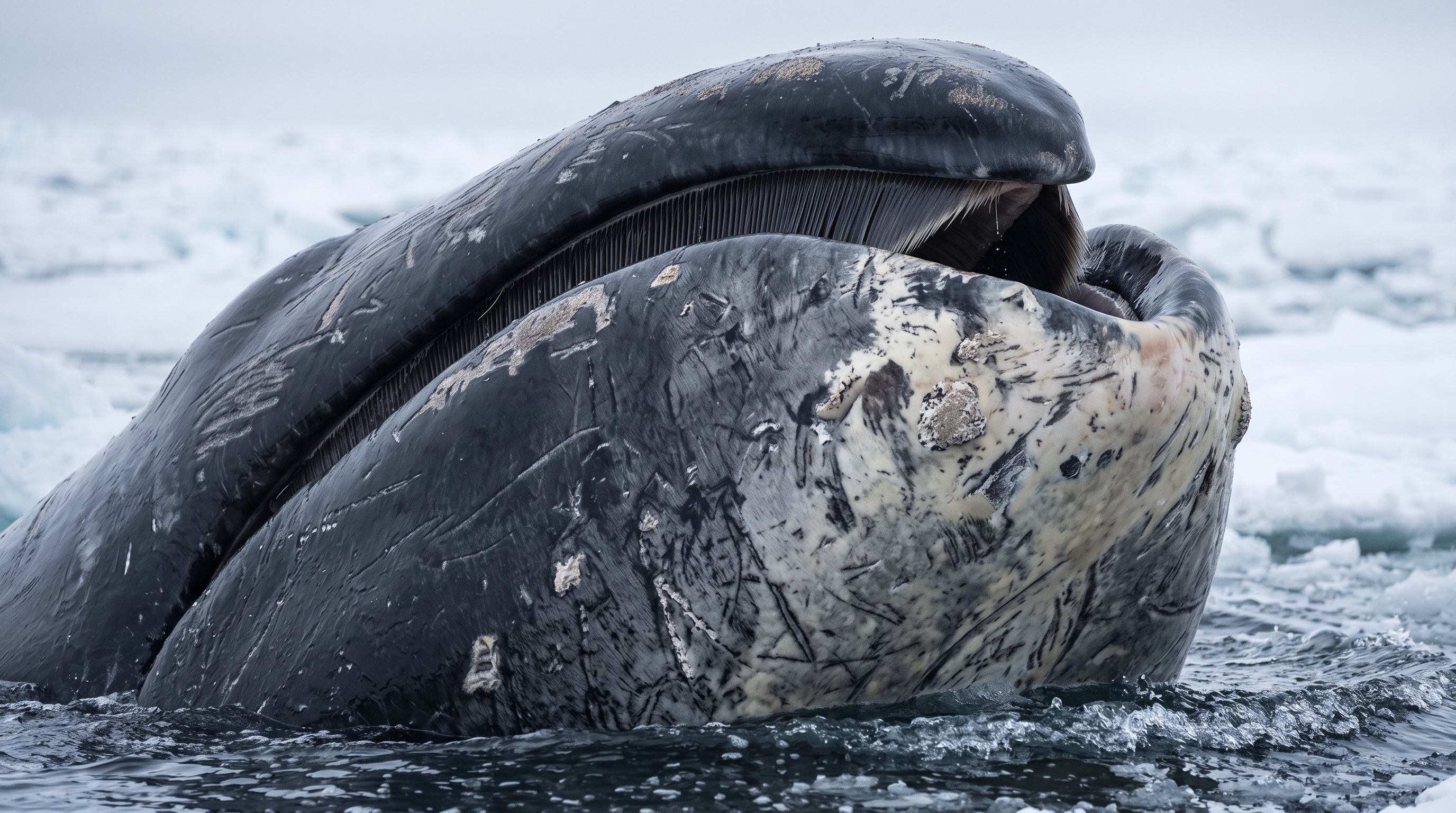
Close view of a bowhead whale's enormous arched jawline and pale chin patch, its skin marked with the scars of decades spent breaking ice
Built for Ice
The bowhead is one of only three cetaceans — with the beluga and the narwhal — that lives in Arctic waters year-round. It does not migrate to warmer seas. It follows the seasonal advance and retreat of the pack ice, and where the ice closes over, it makes its own way through.
NOAA reports that the bowhead's reinforced skull allows it to break through sea ice roughly eight inches thick. Alaska Native whalers have reported animals surfacing through two feet of solid ice. The whale rises beneath the floe and drives its head upward until the ice gives. The scars this leaves are permanent, and researchers use them to identify individual animals.
Feeding without teeth
The bowhead has no teeth. It filters its food through baleen plates that hang from the upper jaw — around 330 per side, each triangular, spaced roughly a centimetre apart, and reaching more than four metres in length. These are the longest baleen plates of any whale. The animal swims slowly with its mouth partly open, straining copepods and krill from the water in continuous mouthfuls.
A single bowhead consumes an estimated one hundred metric tons of prey per year. Its insulating blubber reaches nearly half a metre in thickness — the thickest of any animal — which is what makes a lifetime in freezing water survivable, and which also made the species the most valuable target of nineteenth-century commercial whaling.
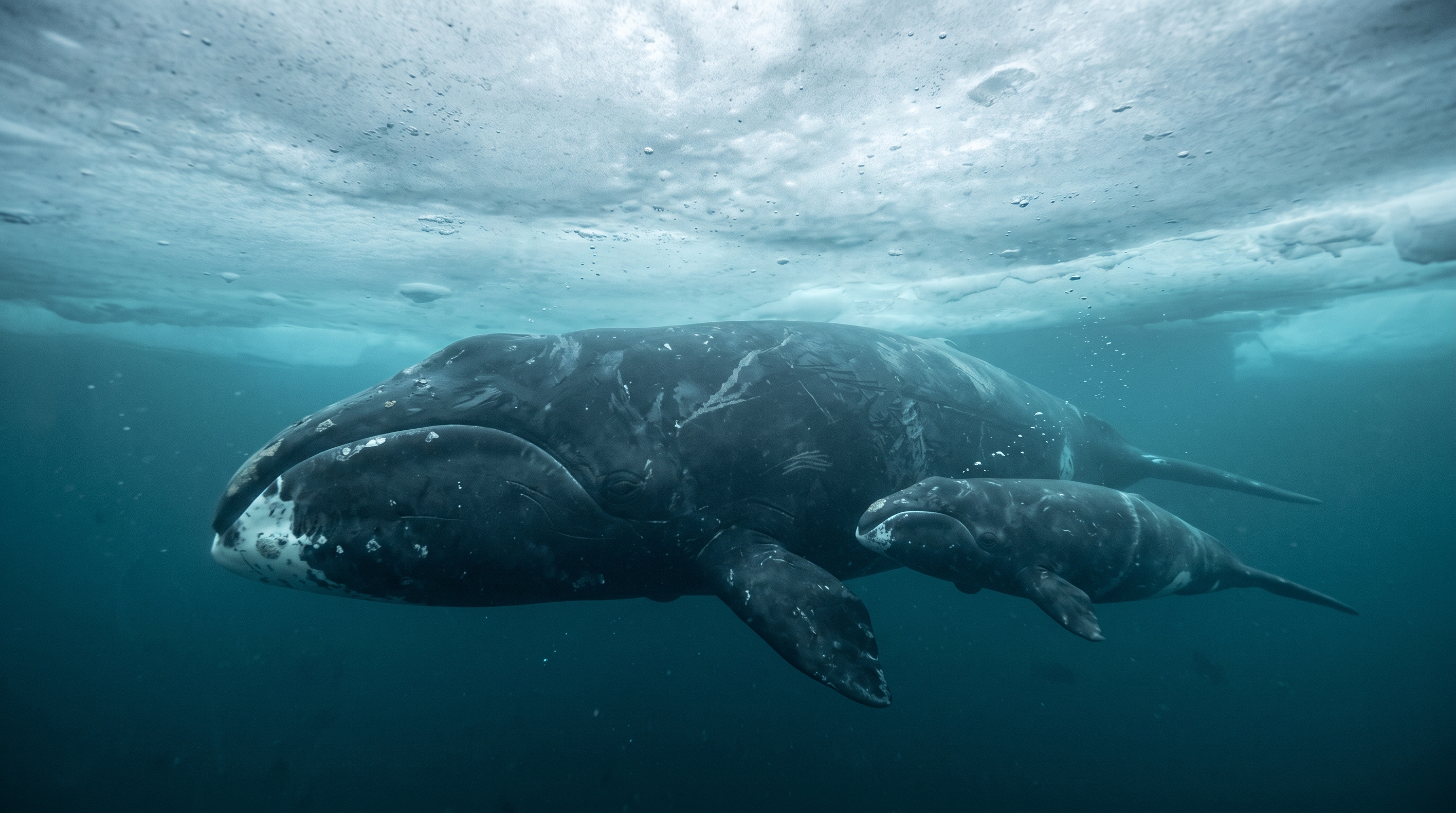
A bowhead whale and calf swimming together beneath the Arctic ice ceiling, pale light filtering down through the frozen surface above them
The Jazz Musicians of the Arctic
Bowheads are among the most vocally elaborate animals in the ocean. They are described as two-voiced: capable of producing high and low frequencies simultaneously, singing two lines at once. Their calls range from sustained moans to sharp impulsive sounds like gunshots, and some vocalisations appear to serve as navigation, helping the whale locate sea ice in total darkness.
In 2018 a University of Washington team led by Kate Stafford published four winters of recordings gathered under the ice east of Greenland. Where a humpback population shares one song that changes slowly through a season, the bowheads produced 184 distinct songs over four years — a repertoire that shifts constantly and appears to have no single shared version at all. Stafford compared it to jazz. Why bowheads sing this way remains unknown.
The population making those recordings, hunted nearly to extinction in the 1600s, was recently estimated at around two hundred animals. The recordings suggested a healthier population than expected.
Whaling, Recovery, and What Comes Next
Commercial whaling reduced the bowhead worldwide to fewer than three thousand animals by the 1920s. The species was among the most heavily targeted in whaling history — slow-swimming, floating when killed, and yielding enormous quantities of oil and baleen.
The recovery has been uneven. The Western Arctic population, protected and co-managed with Alaska Native communities under a subsistence quota system, has recovered substantially. Globally the species is listed as Least Concern. But the picture fragments at the subpopulation level: the Okhotsk Sea bowheads are Endangered, and the East Greenland-Svalbard-Barents Sea stock is Critically Endangered, numbering in the low hundreds and showing little sign of recovery despite protection since the 1930s.
A slow life history in a fast-changing sea
Bowheads reach sexual maturity at around twenty-five years and produce a single calf every three or four years. A species that reproduces this slowly cannot replace losses quickly, which is precisely why commercial whaling was so devastating and why recovery takes generations.
The threats now are different. Arctic sea ice is declining, and the bowhead evolved for a world that has ice in it. Warming water has brought orcas further north into waters where bowheads have historically been safe from them. Increased shipping brings noise into an environment where the whale navigates and communicates by sound. An animal that may live two centuries has time to accumulate the effects of every change we make.
Image Note: Images on this page are artistic interpretations created with AI tools to convey ecological and behavioural context rather than anatomical precision. See our Image Methodology for details.
References
- NOAA Fisheries. Bowhead Whale. https://www.fisheries.noaa.gov/species/bowhead-whale
- NOAA Fisheries. 5 Icebreakers About Bowhead Whales. https://www.fisheries.noaa.gov/alaska/outreach-and-education/5-icebreakers-about-bowhead-whales
- North Slope Borough Department of Wildlife Management. Bowhead Whale Age Estimation. https://www.north-slope.org/departments/wildlife-management/studies-research-projects/bowhead-whales/bowhead-whale-population-studies/age-estimation/
- Keane, M. et al. (2015). Insights into the Evolution of Longevity from the Bowhead Whale Genome. Cell Reports. https://www.ncbi.nlm.nih.gov/pmc/articles/PMC4536333/
- University of Washington News (2018). Bowhead whales, the 'jazz musicians' of the Arctic, sing many different songs. https://www.washington.edu/news/2018/04/03/bowhead-whales-the-jazz-musicians-of-the-arctic-sing-many-different-songs/
- WWF Arctic Programme. Bowhead Whale. https://www.arcticwwf.org/wildlife/bowhead-whale/
- Whale and Dolphin Conservation. Bowhead Whale. https://us.whales.org/whales-dolphins/species-guide/bowhead-whale/
- Discovery of Sound in the Sea. Bowhead Whale Vocalisations. https://dosits.org/galleries/audio-gallery/marine-mammals/baleen-whales/bowhead/